
The Airflow Ring: The Most Useful Control on Your Vape, and the Least Explained
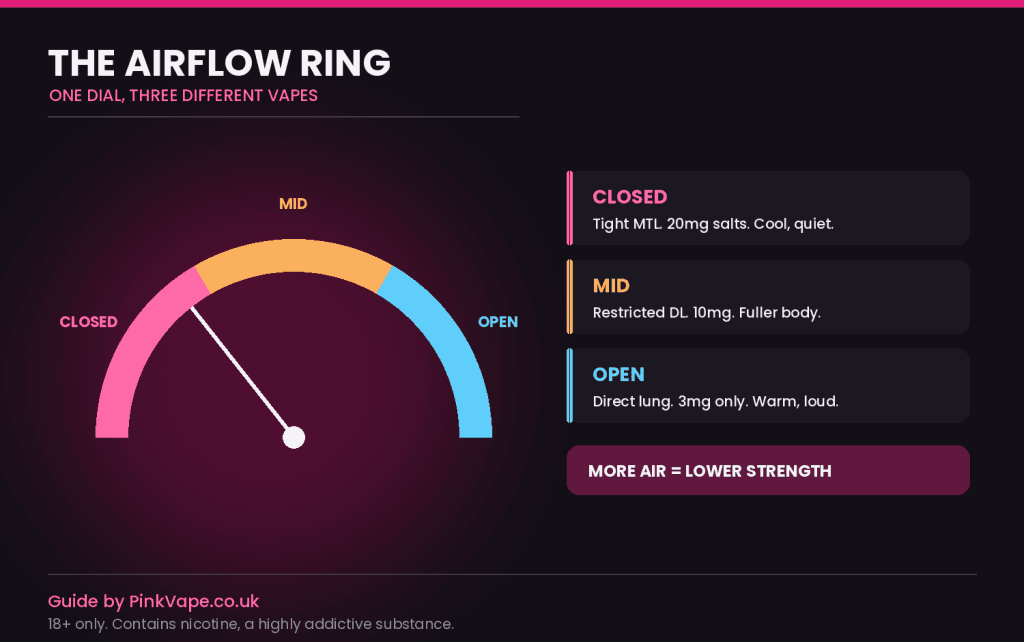
A small collar that most people never touch changes the draw, the flavour, the vapour and how much nicotine reaches you. Here is how to use it properly.
Somewhere on a great many vaping devices there is a ring, slider or collar that adjusts how much air passes the coil when you inhale. It is rarely explained in the packaging, almost never mentioned at the point of sale, and a large proportion of owners either never notice it or move it once and leave it wherever it landed.
That is a shame, because it is the only control on most devices that meaningfully changes the experience without buying anything. It converts a single device into three quite different vapes, and it is the fastest way to work out what kind of draw actually suits you.
Here is what it does mechanically, what each position feels like, and how it interacts with everything else you have chosen.
One collar, three different devices — and the strength has to follow.
What It Does Mechanically
When you draw, air enters the device through small inlets, passes over the coil, picks up vapour and travels out through the mouthpiece. The airflow control simply varies the size of those inlets.
Narrowing them means less air passing the coil for a given effort. The air that does pass moves faster, picks up a higher concentration of vapour, and the resulting draw is cooler because there is less of it. Widening them means more air, lower vapour concentration per unit of air, and a warmer draw because the coil is doing more work.
That is the entire mechanism. Everything that follows — the flavour differences, the nicotine implications, the battery consequences — comes from that one variable.
Closed: Tight Mouth-to-Lung
With the inlets nearly shut, the draw takes noticeable effort and moves slowly. This is deliberately close to the resistance of a cigarette, which is why it is the setting almost every device ships in.
- Feels like drawing on a cigarette — two-stage, into the mouth first.
- Cool, concentrated vapour in modest volume.
- Discreet in public — little visible cloud.
- Suits high nicotine strengths, 10mg or 20mg salt.
- Longest battery life and slowest liquid consumption.
For anyone who has switched from smoking, this is the correct starting position and often the correct permanent one. There is no implication that you should progress away from it.
Mid: Restricted Direct-Lung
Opening the inlets partway produces a draw you can inhale straight to the lungs but that still offers resistance. This is where a great many experienced vapers settle.
- Fuller, rounder flavour — more vapour carrying the same profile.
- Warmer than the closed position, noticeably so.
- Suits around 10mg salt, or 6mg freebase depending on the coil.
- Moderate battery and liquid consumption.
If you have been vaping mouth-to-lung for a while and want more from it, this is a better next step than jumping straight to fully open. It is also the position where most devices sound and feel at their best.
Open: Direct-Lung
Fully open, air moves freely and the coil works hard. The draw is effortless, more like breathing than sucking.
- Warm, voluminous vapour — conspicuous rather than discreet.
- The most vapour and, on a well-matched coil, the richest flavour.
- Requires low nicotine strength, typically 3mg.
- Consumes battery and liquid quickly — often several times the closed rate.
This suits people who enjoy vaping as an activity. It is a poor setting for somebody who switched recently, because the nicotine strength it demands will not satisfy a smoker’s habit.
The Rule That Ties It Together
Airflow and nicotine strength are not separate decisions. They are one decision, and this is the part nobody explains.
The more air a device moves, the more vapour reaches you per puff — and therefore the more nicotine, at any given strength. Open the airflow without lowering the strength and each draw delivers substantially more nicotine than it did before.
| Airflow | Nicotine | What happens if you get it wrong |
|---|---|---|
| Closed | 20mg salt | 3mg here never satisfies; you vape constantly |
| Mid | 10mg salt | Either extreme is tolerable but not ideal |
| Open | 3mg freebase | 20mg here is genuinely unpleasant |
That bottom-right cell is worth taking seriously. Fully open airflow with a high-strength salt produces immediate light-headedness and nausea, and it is one of the more common ways people conclude that vaping does not agree with them.
How to Find Your Setting
- Start fully closed with whatever strength matches your smoking habit.
- Live with it for two or three days. First impressions of any new setting are unreliable.
- If it feels restrictive or the flavour seems thin, open it by about a third.
- Give that another couple of days before judging.
- If it starts feeling harsh as you open up, that is the nicotine rather than the airflow — drop a strength on your next bottle.
- Once you find a setting you like, leave it. The purpose is discovery, not constant adjustment.
Two or three weeks of that tells you something genuinely useful about yourself as a vaper, and it carries over to every device you buy afterwards. If you are choosing hardware and are undecided about draw style, a kit with an adjustable ring is worth prioritising — listings at pinkvape.co.uk state whether airflow is adjustable or fixed, and it is a specification worth filtering on.
When There Is No Ring
Plenty of devices, particularly prefilled pod kits and the simplest refillables, have fixed airflow. That is a deliberate choice rather than a cost saving: the manufacturer has tuned the airway to suit the one coil the device uses, and for a device aimed at former smokers there is a reasonable argument that fewer controls is better.
If yours is fixed, your equivalent control is coil resistance. Higher resistance behaves like closed airflow; lower behaves like open. On a sealed device with neither option, the draw is what it is — and if it does not suit you, that is a reason to look at a different device rather than a fault to troubleshoot.
What Else the Setting Affects
Beyond the draw itself, the position of that ring quietly changes several things people usually attribute to other causes.
| Closed | Open | |
|---|---|---|
| Battery life | Longest | Noticeably shorter |
| Liquid consumption | Slowest | Several times faster |
| Coil life | Longer, runs cooler | Shorter, runs hotter |
| Discretion | High | Low |
| Flavour character | Concentrated, sharper | Fuller, warmer, more diffuse |
| Noise | Quiet | Audible airflow |
That third row explains a common complaint. Somebody opens the airflow, enjoys the extra vapour, and then finds their coils dying in days rather than weeks. Nothing is faulty — the coil is simply working several times harder than it was.
The battery row explains another. A device that comfortably lasted two days at a closed setting may struggle to see out one when opened up, which people often mistake for a failing cell.
Frequently Asked Questions
Which way is closed?
Usually rotating the ring so the visible inlet holes are covered. Most devices have a marking, and you can hear the difference in the draw immediately.
Should I change it often?
No. Use it to find a setting you like, then leave it. Constant adjustment mostly produces confusion.
Why did opening it make the vape harsh?
More air means more nicotine per puff. Lower the strength or close it back down.
Does airflow affect battery life?
Considerably. Open airflow runs the coil harder and drains the battery noticeably faster.
Does it affect leaking?
It can. Very open airflow on a device designed for a tight draw sometimes allows liquid into the airway.
Can it change flavour?
Yes, substantially. Tighter airflow concentrates flavour; more open airflow gives fuller but less concentrated flavour.
My device has no ring. Is that a problem?
Not at all. Fixed airflow is normal on devices tuned for one coil and one purpose.
Airflow and Leaking
A connection worth knowing, because it explains a problem people usually blame on the pod.
The inlets that let air in can also let liquid out, particularly on a device tuned for a tight draw that has been opened up. If your device began leaking shortly after you adjusted the airflow, try closing it back a little before concluding the pod is faulty.
- Very open airflow on a small MTL device can allow liquid past the coil into the airway.
- Thin, high-PG liquid compounds this, since it flows more freely.
- Storing a device on its side with open airflow is the worst combination — upright storage matters more the further open the ring is.
None of this argues against using the control. It argues for changing one thing at a time, so that when something changes you know which adjustment caused it.
The Short Version
The ring changes how much air passes the coil, and everything else follows. Closed gives you a tight, cool, cigarette-like draw suited to strong nicotine. Open gives you a warm, voluminous, conspicuous draw that requires weak nicotine.
Start closed, open gradually, and drop your strength as you go. The one combination to avoid is wide-open airflow with a high-strength salt. If you are shopping for hardware and want the option, Pink vape buy listings and most UK specialists state whether a kit has adjustable airflow — it is worth filtering on, because it is the cheapest way to find out what draw suits you without owning two devices.
Age restriction and health notice
This article is intended for adult smokers and vapers aged 18 or over. Vaping products contain nicotine, which is a highly addictive substance. They are not suitable for non-smokers, under-18s, or anyone who is pregnant or breastfeeding. If you are trying to stop smoking, your local NHS Stop Smoking Service offers free support.